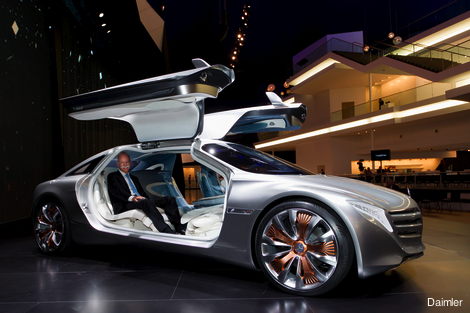
Mercedes-Benz has unveiled a fuel-cell concept car, the F125, at the Frankfurt motor show. The new car has a fuel cell stack centrally located under the bonnet at the front and four individual electric wheel motors.
Metal organic hydrogen reservoir supplies fuel cell
The hydrogen reservoir, which is made from a composite material, has a capacity of around 7.5kg and is located in the centre tunnel, between the front seats and the floor assembly where it is protected against possible collision damage.
The reservoir is built using a metal organic framework (MOF), a porous structure which has a very large surface area - up to 10,000sq m per gram. Mercedes says that the highest storage density uses the MOF as a pressurised container (operating at 30-80 bar) at a low temperature of 77K (about -196degC), which is still far about the 20K boiling point of hydrogen.
The MOF can be varied in shape, which Mercedes says means they can be flexibly installed in a vehicle to suit its requirements. Key advantages are:
- Compact installation means more scope for packaging and more room for the occupants
- The low installed position is conducive to a low centre of gravity, improving handling and driving dynamics
- Full integration into the bodyshell structure ensures the best possible crash and operating safety
Lithium-sulphur battery with a high energy density
F125 has a lithium-sulphur battery installed behind the rear seats, which has a storage capacity of 10 kWh. This can be inductively charged at "intelligent" charging stations, the process being monitored and controlled using a smartphone.
Lithium-sulphur architecture offers higher energy density, allowing the battery to be smaller and lighter for a given capacity. Mercedes designers are predicting that by the time this technology is ready for production, these batteries will have a capacity of 350Wh/kg which is double the current level of performance.
Wheel motors and air suspension
The rear-end drive module of F125! is a development of that seen on last year's SLS AMG E-CELL, but the front end uses a completely new layout.
Mercedes says the new front axle design positions the drive components for optimal weight distribution. Active torque vectoring assigns power to each motor individually based on vehicle attitude in corners, to avoid understeer and oversteer. The system allows "a metered increase in the yaw rate with an improved steering response and less steering effort", which is a technical way of saying a four-wheel drift.
According to Mercedes the drive configuration also allows highly efficient energy recuperation at each wheel, cross-wind stabilisation, avoidance of load-change responses and therefore even more controllable handling when cornering, without the need for traction control intervention.
The F 125! is the first electric car to feature air suspension with continuous damper adjustment. The system also allows the vehicle's ride height to be adjusted as a function of speed and road conditions. Mercedes says the suspension system has "special compensation of drive moments in the front axle", which it says almost eliminates power on/power off influences on the steering and noticeably reduces pitching.