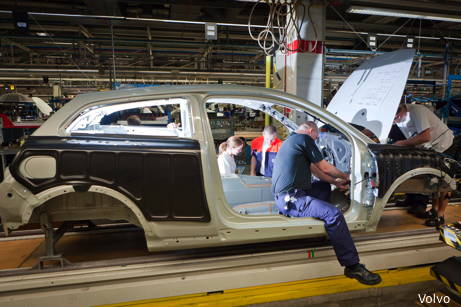
Volvo has begun production of its C30 Electric model. The base vehicle is built on the regular C30 assembly line in the Ghent factory and then transported to Volvo's Special Vehicles workshop in Göteborg for installation of the motor, batteries and other model-specific electronics.
The Volvo C30 Electric will be delivered to leasing customers throughout Europe, including in Sweden, Belgium, the Netherlands and Norway. Initial deliveries to leasing customers, mainly companies, authorities and governmental bodies, will take place in early autumn.
Volvo expects to build about 250 C30 Electrics by end 2012, but has not ruled out the possibility of making more if market interest is strong.
Tests on a fleet of about 50 cars have been conducted since autumn 2010, mainly internally at Volvo Car Corporation.
The C30 Electric has an operating range is up to 150km (93 miles) on a full charge, which takes about seven hours. The top speed is 130km/h (81mph) and acceleration from 0-50km/h (31mph) takes four seconds.
Building the Volvo C30 Electric
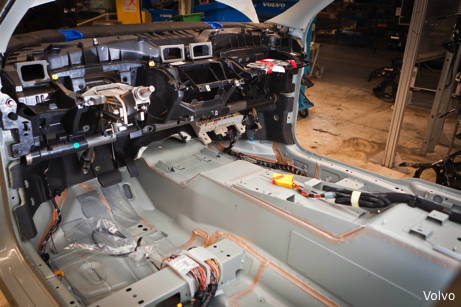
C30 Electric in the welding plant in the Volvo Cars Ghent (Gent) plant. The tunnel console is higher than in the internal combustion engined C30s models to provide space for the Lithium-Ion battery.
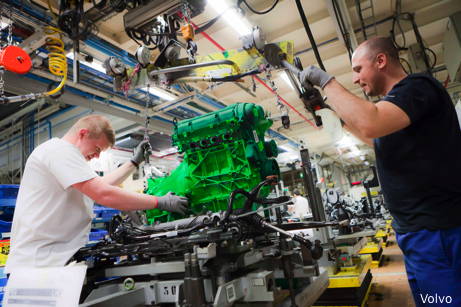
A dummy engine is installed on the production line to keep the part-built car balanced as it moves around the production line. It is then taken out before the vehicle is shipped to Göteborg for installation of the electric motor.
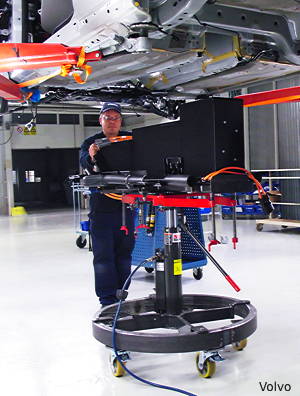 Installation of the Lithium-Ion batteries in Volvo's Special Vehicles workshop in Göteborg. The two 140kg batteries are installed where the fuel tank normally is situated and also in a special compartment in the car’s central tunnel. As a result, the luggage compartment is unchanged from a regular C30. The C30 Electric stores 24kWh in its battery pack, of which 22.7kWh is used to power the car.
 Installation of the electric engine in Volvo Cars Special Vehicles' workshop in Göteborg. The motor produces 111hp and 220Nm of torque.